Get 20% OFF Hair Transplant Packages This New Year — Book Today!
Sapphire FUE Hair Restoration: Complete Cost and Results Guide

Get in touch with our expert today
Get 20% Off
Not every upgrade in hair transplant technology is worth the attention it gets. Some are marketing rather than medicine. Sapphire FUE is the exception. The change from steel to sapphire-tipped blades for channel creation is a small thing on paper but it produces a genuinely different experience and, in the hands of a skilled surgeon, meaningfully better outcomes. If you’re weighing up hair transplant options and this technique keeps coming up, here’s what it actually is and whether the cost difference makes sense.
What Is a Sapphire FUE Hair Transplant?
How Sapphire Blades Improve FUE Hair Transplant Results
The sapphire in sapphire FUE hair transplant refers to the blade material used to create the recipient channels. In standard FUE, steel micro-blades are used to make the tiny incisions in the scalp where grafts are placed. Sapphire blades are made from a synthetic gem material that’s considerably harder than surgical steel. The edge is sharper, smoother, and holds its precision longer through a procedure.
What that smoothness does in practice is create cleaner, more consistent channel walls. Cleaner incisions cause less tissue trauma. Less trauma means less inflammation. Less inflammation translates to faster healing, better graft survival, and a final result that looks more natural because the surrounding tissue is healthier. It’s a chain of small improvements that adds up. The channels also open with less physical force, which reduces the mechanical stress on the scalp during the procedure itself.
Benefits of Sapphire FUE Compared to Traditional FUE
Reduced swelling and faster surface healing is the most noticeable short-term benefit. Patients who’ve had traditional FUE at one clinic and sapphire FUE at another often report the sapphire procedure felt less aggressive during recovery. The channel precision also allows surgeons to work at higher graft densities in a single session, because the incisions can be placed closer together without compromising blood supply to adjacent grafts. That’s a meaningful advantage for patients needing high-density coverage in a single pass.
The sapphire blade’s hardness means it degrades more slowly during a long procedure than steel does. Steel blades blunt incrementally throughout a session. By graft 1,800 the incisions being created aren’t quite the same as the first 200. Sapphire holds its edge more consistently across the full procedure duration, which matters most on larger sessions of 3,000 grafts or more.
Sapphire FUE Hair Transplant Cost Worldwide
Average Sapphire FUE Cost by Country
The cost varies enormously depending on location and clinic tier. Turkey sits at a fraction of what Western European and North American clinics charge for the same procedure. The fue cost in Istanbul at a reputable specialist clinic typically runs $1,500 to $3,500 for a standard-sized session. The same procedure in London or New York costs three to five times that figure. The table below gives a country-by-country overview.
| Country | Sapphire FUE Cost | Standard FUE Cost | DHI Cost |
| USA | $5,000 to $12,000 | $4,500 to $10,000 | $6,000 to $14,000 |
| UK | £4,000 to £9,000 | £3,500 to £8,000 | £5,000 to £11,000 |
| Germany | €4,500 to €10,000 | €4,000 to €9,000 | €5,500 to €12,000 |
| Turkey | $1,500 to $3,500 | $1,200 to $3,000 | $2,000 to $4,000 |
| Poland | €1,500 to €4,000 | €1,200 to €3,500 | €2,000 to €5,000 |
| India | $800 to $2,500 | $600 to $2,000 | $1,000 to $3,000 |
Factors That Affect Sapphire FUE Hair Transplant Cost
Graft count is the primary driver. A 1,500-graft session addressing early recession costs considerably less than a 4,000-graft session covering a Norwood 5 or 6 pattern. Some clinics price per graft and others offer fixed-price packages for sessions up to a certain graft count. Per-graft pricing makes more sense for patients with smaller needs. Fixed packages tend to favour patients needing larger sessions where the per-graft rate at high volumes would otherwise be significant.
Clinic reputation and surgeon seniority also affect price. A senior surgeon performing the procedure personally, rather than delegating extraction and implantation to technicians, commands a higher fee. That premium is often worth it. The quality of graft handling, extraction consistency, and channel placement are all directly tied to the hands doing the work, not just the technique being applied.
Sapphire FUE Hair Transplant Cost Comparison Table
The table above covers the main markets. Turkey’s position at the lower end of the range isn’t a reflection of lower quality at the leading clinics. It’s a reflection of lower operational costs, currency dynamics, and a competitive market that keeps pricing honest while the volume of procedures performed supports genuine expertise at scale.
Why Sapphire FUE Is More Affordable in Turkey
Hair transplant in Turkey has become the benchmark for affordable, high-quality procedures and sapphire FUE follows that same pattern. Istanbul clinic overheads are genuinely lower than equivalent facilities in London or Dubai. Surgeon salaries, facility costs, and consumables are all denominated in Turkish lira, while patients pay in dollars or euros. That currency dynamic means Turkish clinics can offer internationally competitive pricing without compromising on equipment or technique.
The volume effect matters too. Istanbul clinics performing thousands of sapphire FUE procedures per year have refined their protocols in ways that smaller-volume Western clinics haven’t. That refinement shows in efficiency, consistency, and the depth of specialist support staff built around the procedure. It’s one of the reasons that even patients from the UK and US who could afford domestic pricing often choose hair transplant in Turkey for this specific technique.
Sapphire FUE vs DHI Hair Transplant
Key Differences Between Sapphire FUE and DHI Techniques
Both techniques use FUE for donor extraction. The difference is in how grafts are placed into the recipient area. Sapphire FUE creates the channels first, then grafts are placed into them separately. DHI uses a Choi implant pen that extracts and places each graft in a single step, without a pre-created channel. The implanter controls depth, angle, and direction in one motion. That sounds more precise but the reality is more nuanced than the marketing usually suggests.
Which Method Offers Better Density and Natural Results?
Sapphire FUE allows more grafts per square centimetre in a single session, mainly because channels can be pre-planned and distributed at optimal spacing before any graft is placed. With DHI, each graft is placed as it’s loaded into the implanter, which limits the ability to pre-map the full distribution. For patients needing very high density over a large area, sapphire FUE often delivers more comprehensive coverage in a single session. DHI’s advantage is in precision for smaller areas, hairline refinement, and procedures where the recipient site doesn’t need to be shaved.
Graft Survival Rates: Sapphire FUE vs DHI
Both techniques produce high graft survival rates when performed correctly. The survival rate in either case is more dependent on how grafts are handled outside the body, the skill of the extraction team, and how quickly grafts are implanted after extraction, than it is on the technique itself. Claims that DHI produces dramatically higher survival rates than sapphire FUE aren’t consistently supported by clinical evidence. A well-run sapphire FUE session with properly preserved grafts will outperform a poorly managed DHI session every time.
Step-By-Step Sapphire FUE Hair Transplant Procedure
Consultation and Hairline Design
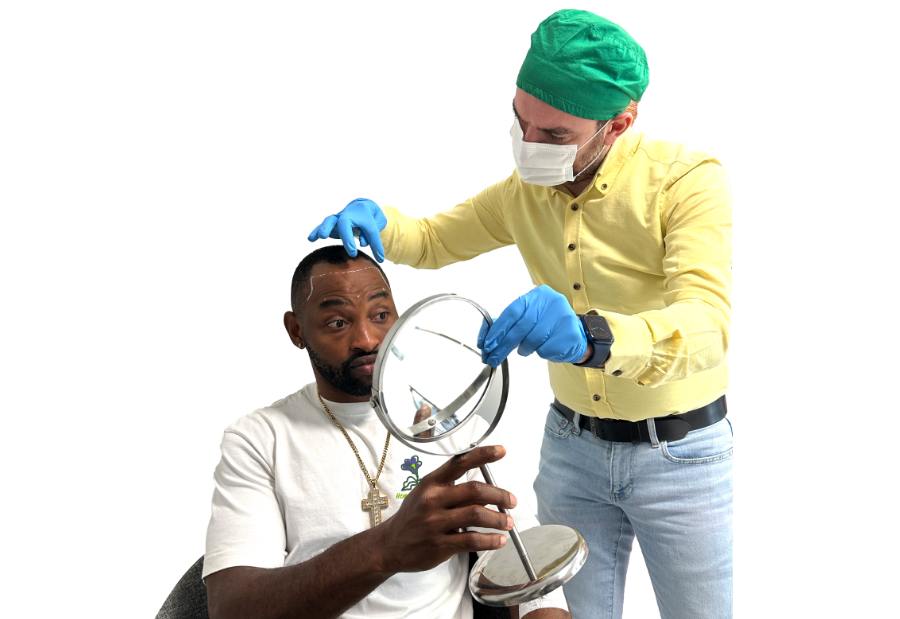
The consultation is where the procedure’s success is largely determined. A thorough assessment covers donor density, recipient area extent, hairline position, and realistic graft count. Hairline design involves drawing the proposed line on the patient’s scalp and adjusting until both the surgeon and patient are aligned on what will look natural given the patient’s facial structure, age, and likely future hair loss progression. Rushing this phase is one of the most common sources of unhappy long-term outcomes.
Want to Have the Best Hair Transplant Experience?
Book Free Consultation Today
Donor Hair Extraction
The donor zone, typically the back and sides of the scalp, is shaved and local anaesthetic is administered. Individual follicular units are extracted using a rotary punch, usually 0.7 to 0.9mm in diameter for sapphire FUE. The surgeon works across the donor area systematically, maintaining even distribution to avoid depleting any single zone too heavily. Extracted grafts go immediately into a chilled, oxygenated preservation solution. The time grafts spend outside the body is tracked and managed throughout the session.
Channel Opening With Sapphire Blades
This is the defining step of the sapphire FUE procedure. The surgeon uses sapphire-tipped micro-blades to create receiving channels in the recipient area. The angle, depth, and direction of each channel determines how the transplanted hair will grow and whether the final result looks natural. In areas where hair needs to lie flat and flow in a consistent direction, the channel design is precise and deliberate. This step takes significant time on larger sessions and the surgeon’s concentration and technique during it affects the entire aesthetic outcome.
Graft Implantation
Once channels are created, grafts are placed using fine forceps. The handling is gentle. Follicles are fragile outside the body and any crush damage to the graft during placement reduces the likelihood of that follicle surviving and producing a hair. Experienced implantation teams work quickly but not hurriedly, maintaining graft integrity through each placement. Single-hair grafts go into the finer areas near the hairline. Multi-hair units fill the denser zones further back.
Recovery and Initial Healing
The first three days involve swelling, some tenderness, and the appearance of small scabs around each graft. These are normal. Sleeping slightly elevated reduces swelling in the forehead area. Patients are given a specific washing protocol, usually beginning on day three or four, using diluted saline misted over the scalp before gentle washing with a mild shampoo. No rubbing, no direct water pressure, no touching the grafts during the first ten days.
Early Hair Growth Phase
The hair shafts that have been transplanted usually fall out two to six weeks after the operation. It is normal and does not imply that the grafts have failed. The follicles stay in the scalp and get a period of rest and then start growing again. Patients see the first new hairs appearing at around three to four months. The growth is initially fine and lacks full pigment, often appearing lighter than the patient’s natural colour. By six to eight months the hair thickens and darkens and the result becomes much more visible.
Recovery Timeline and Post-Procedure Care
First Week After Sapphire FUE
Days one through three are the most significant. Swelling peaks around day two and resolves by day four or five in most patients. Scabs form around each graft and should not be picked or disrupted. The sapphire technique’s lower trauma response means swelling and redness tend to be less severe and resolve faster than after traditional steel FUE. Most patients are comfortable returning to normal desk-based activity by day four or five, though strenuous exercise and direct sun exposure should be avoided for at least two weeks.
Hair Growth Timeline After Sapphire FUE
Month one through two: shedding phase. Month three: first new growth visible, often fine and light. Month four through six: increasing thickness and density, result becoming clearly visible. Month six through nine: significant improvement, most patients very happy with progress. Month twelve: approximately 80 to 90 percent of final result visible. Month eighteen: full maturation, final density and natural hairline appearance established. The patience required between procedure and full result is the hardest part for most patients.
Tips for Faster Healing and Better Results
Stay hydrated. It sounds basic but proper hydration supports tissue healing and graft survival in the first weeks. Avoid alcohol and smoking for at least two weeks post-procedure, both impair blood supply and slow healing. Sleep on a clean pillowcase and use the washing protocol exactly as instructed. Avoid swimming pools and gyms for three weeks. Use the prescribed post-operative products if provided. And honestly, be patient. The timeline is the timeline. Healthy habits support it but don’t significantly accelerate it.
Sapphire FUE Results: What to Expect
Before and After Results
Sapphire FUE before and after results, when the procedure has been performed by an experienced surgeon, are consistently strong. The combination of precise channel placement and reduced tissue trauma produces natural-looking hairlines and density that holds up well to scrutiny. The key variable is always surgeon skill and graft handling quality. The best sapphire FUE results come from procedures where the hairline design was thoughtful, the extraction was clean, and the channel placement was mapped carefully to produce a result that looks as if the hair simply never left.
Natural Hairline and Density Outcomes
A well-designed hairline has soft, irregular edges rather than a straight line across the forehead. Single-hair grafts at the front, transitioning to two and three-hair units further back, create the gradient that hair naturally grows in. The sapphire blade’s precision in channel placement makes this transition more controllable than in standard FUE. At twelve to eighteen months, patients with good donor density and an appropriately scoped procedure can achieve coverage that’s genuinely difficult to identify as transplanted hair.
Long-Term Success Rate of Sapphire FUE
The transplanted follicles are permanent. They don’t follow the same loss pattern as native hair in the thinning areas because they’re genetically DHT-resistant. The success rate at established clinics, measured by graft survival and patient satisfaction at twelve months, runs at 85 to 95 percent for well-selected candidates with experienced surgical teams. The patients who are disappointed are usually those who had unrealistic expectations, insufficient donor density for the coverage they wanted, or chose clinics based on price alone without vetting the surgical team’s specific experience with the procedure.
Who Is a Good Candidate for Sapphire FUE Hair Transplant?
Ideal Hair Types and Hair Loss Stages
Norwood 2 through 5 patients with adequate donor density are the strongest candidates. Hair with good calibre and density in the donor zone provides more visual coverage per graft in the recipient area. Patients whose hair loss has stabilised, or who are managing ongoing loss with medication like finasteride, are better candidates than those whose loss is still actively progressing rapidly. Age matters too. Performing a sapphire FUE hair transplant on a 22-year-old with early recession and unpredictable future loss trajectory is a different risk profile from a 38-year-old whose pattern has been stable for several years.
When Sapphire FUE May Not Be Recommended
Patients with very poor donor density who have already lost a significant proportion of their scalp hair may not have enough available grafts to achieve meaningful coverage. Advanced Norwood 6 or 7 patients sometimes need to consider realistic expectations around what’s achievable rather than pursuing a procedure that won’t produce the result they’re hoping for. Active scalp conditions, certain autoimmune hair loss types like alopecia areata, and patients on blood thinners or certain medications need medical clearance before proceeding. A thorough consultation with honest assessment of donor supply is the only reliable way to know whether the procedure is right for a specific individual.